Secured ₩29B in government funding and ₩10B in donations
Problem
I wanted to turn the Culture Center, run down and barely used, into a landmark for SNU and a culture platform woven into the everyday life of its members. He was also looking for a case for extending the light rail into campus, and thought that sharing a rebuilt Culture Center with the surrounding community might be exactly that. And one question kept coming back: we envy students at universities abroad stretched out on the lawn, so why had we fenced off the lawn in front of our own administration building?
Process
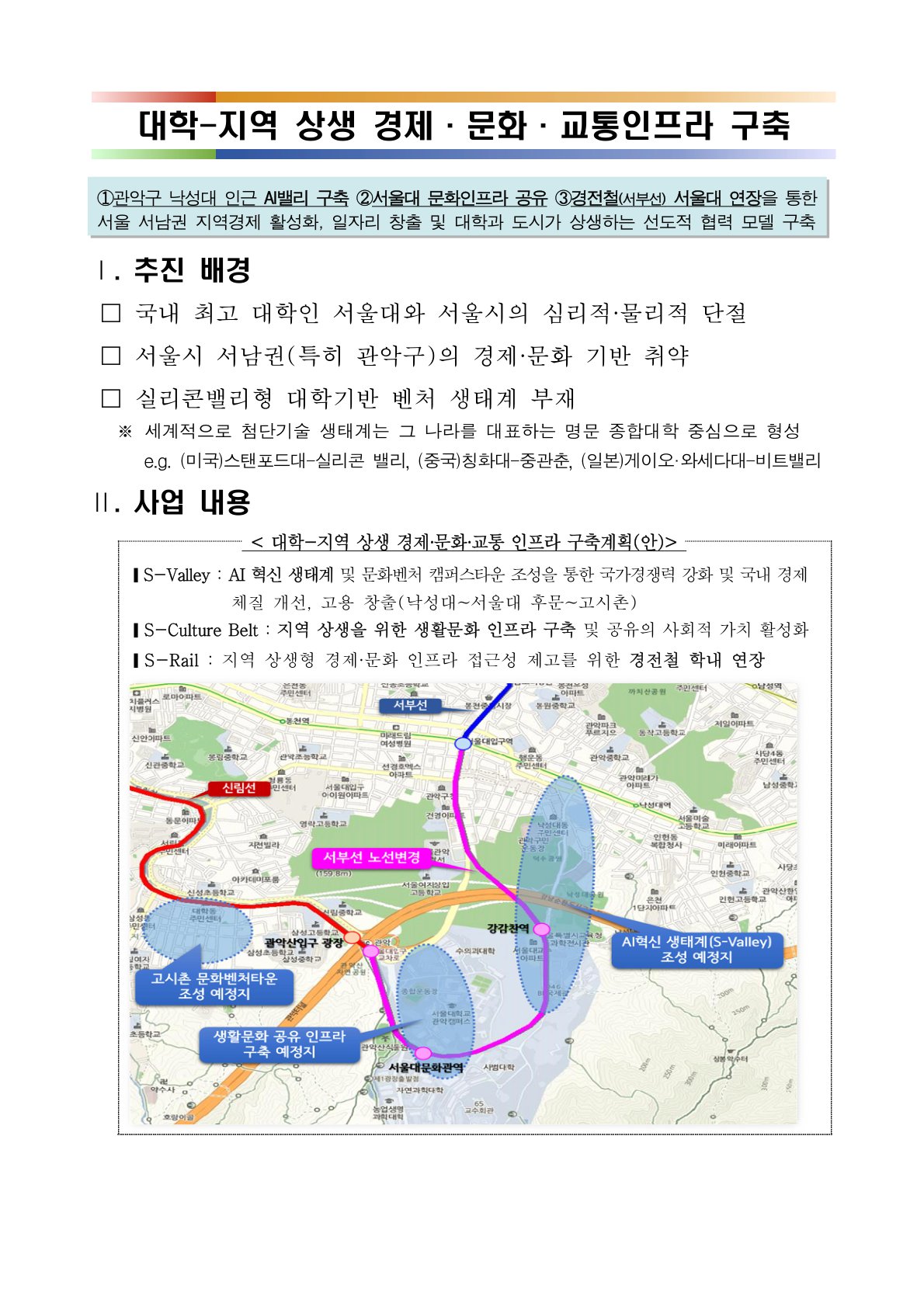
I brought three things together, the Gwanak AI Valley (economy), the Culture Center rebuild (culture), and the light rail (transport), and proposed them to the Seoul Metropolitan Government as one university and community project for shared economic, cultural, and transport infrastructure. Seoul responded well. That moved the Culture Center rebuild forward, and he went on to persuade the Ministry of Economy and Finance to put up the government contribution.
We set a strategy that tied the Culture Center rebuild to the light rail and pushed both at once.
Result
At the time, we secured 29 billion won in government funding, the maximum amount that could avoid a preliminary feasibility review, out of the projected 91.7 billion won construction cost. We also persuaded the son of KCC Information & Communications chairman Lee Joo-yong to make a 10 billion won donation to the Culture Center. In addition, we converted the closed lawn in front of the Administration Building into an open lawn plaza connected to the Culture Center as its forecourt. We built an underground parking lot at the same time as the lawn plaza, but I regret that we could not make it larger because of the prospect of light rail and the limits of the construction budget.
The one-page project outline I always kept close during my two years as Vice President for Planning.