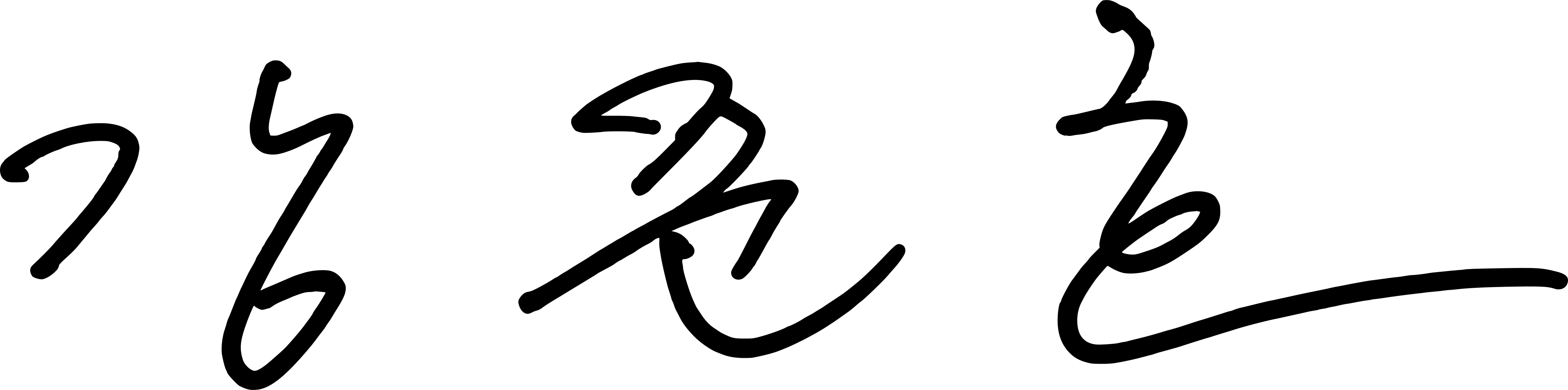
Statement
Contents
Seoul National University has been part of the longest stretch of my life. Here I studied, taught students, and held several administrative posts while wrestling with the university's problems large and small. I know SNU's possibilities better than anyone, and I have also seen up close how institutions and convention can keep those possibilities from unfolding. Now I am stepping forward to begin SNU's next change.
Once again, the world is asking the university's intellect for answers. Artificial intelligence is fundamentally changing how we learn, research, and produce knowledge, while the climate crisis, a reshaped international order, and social polarization are unsettling the order we have taken for granted. In an age when no one can easily answer where to go, SNU must answer the world's questions before anyone else. As universities around the world compete fiercely for talent and research, we cannot remain at what we have achieved. We too must change. Adding a few new projects or adopting fashionable systems is not enough. For SNU to take a higher step, we must change the university's substance and operating system.
The starting point is the members. Faculty must be able to immerse themselves in big questions, students design their own learning, and staff exercise their expertise to solve the university's problems. Colleges should move autonomously according to their distinctive character, and different disciplines should meet freely across boundaries. I believe autonomy and connection make this possible. When members can exercise their abilities freely and excellence connects across the university, SNU can take on questions that have no answer yet and open new possibilities. A university that does not rest on past achievements or relative standing, but sets the standard of a new era. A network of people and knowledge that carries outstanding achievement into greater value for society and the world. That is the SNU I want to build. Taking on challenges first through the power of autonomy and connection. That is what I call Pioneering, the SNU Way.
“Change is practice.”
My administrative experience taught me that change begins not when it remains an idea or declaration, but when it is put into practice. As vice president for planning, I solved the biggest tax problem since incorporation through the fundamental remedy of tax law reform. In turning SNU's main gate into an open, people-centered plaza, I listened directly to opposing members and patiently coordinated different views to break old conventions and make change. As dean of the College of Education, I prepared early for the educational changes brought by the AI revolution and demographic decline and built Korea's first learning-science research and education system. As a professor of sport management, I proposed a new national project directly to the government to strengthen Korea's sports diplomacy and trained next-generation sport-administration leaders from 59 countries over 13 years.
The situations differed, but my way of solving problems was consistent. Break through what is blocked, open what is closed, and create what did not exist. Even when there was no precedent and interests were entangled, I started what SNU truly needed. I connected people and resources, listened to and coordinated different views, and kept working until ideas became real institutions and results. When we make a path one step at a time, a channel for change opens at some point. Through that process I learned that someone must start the changes that are needed, and that whoever starts must take responsibility to the end.
Listen fully and find answers together, but decide and act when the time comes. That is the leadership I learned at SNU and the principle I will keep as president. I will ask again whether long-standing practices still serve today's SNU. I will remove needless barriers and change institutions and conditions so members can exercise their abilities and will freely. SNU's excellence must become real achievement rather than remain a possibility.
The change I am setting out to start looks to SNU's more distant future. Twenty years from now, SNU will mark its centennial. I hope the SNU of that day will be a university where the world's brightest minds gather, explore freely and connect, and set the standards of the era with new knowledge. I hope it will become a rich and sustainable knowledge ecosystem in which foundation and frontier, tradition and future are in harmony. I dream of it standing tall, growing with Korea, as a global leading university that represents Asia and contributes to the world.
No single presidential term can complete everything. But the changes that will decide the next 20 years must begin now. However difficult and long it may take, I will not avoid what SNU truly needs. I will find answers together with the members and see through to the end what we decide.
I will open SNU's possibilities wider and take responsibility for the start of a change that sets the standard of the era once again.
Education and Career
- First Korean professor of sport management at a US Research I university, the University of Connecticut
- Member, IOC Olympism 365 Commission
- International adviser, Singapore's national sport policy
- First editorial board member of Asian nationality at the Journal of Sport Management, the field's leading journal
- Editorial board member of the International Journal of Sport Finance, the International Journal of Sport and Health Science, and other journals
- Vice president, Korean Society of Sport Industry and Management and Korean Society of Sport Policy
- Current member, Fiscal Policy Advisory Committee, Ministry of Planning and Budget (formerly Ministry of Economy and Finance); former public institution evaluation committee member
- Former policy advisory, policy evaluation, and regulatory reform committee member, Ministry of Culture, Sports and Tourism
- Former fund deliberation committee member, Korea Sports Promotion Foundation
- Current outside director, Green Cross Corp.; former outside director, FILA; former outside director, Korean Basketball League (KBL)
- Expert and advisory committee member, PyeongChang 2018 Olympic Winter Games Organizing Committee
- Former planning and finance committee member, Korean Sport and Olympic Committee; former advisor to the KBO commissioner; former marketing committee member, World Taekwondo
- As chairman of the Chan Ho Park Foundation, a mentor to Korea's leading athletes including Chan Ho Park and Young-pyo Lee, extending sports leadership into society
- First SNU Research Achievement Award (2007, predecessor of today's SNU Research Award)
- Commendation from the Deputy Prime Minister and Minister of Education and Human Resources Development (2007)
- Director, arts-and-culture program for creative leaders, SNU Museum of Art
- Steering committees of the Culture and Arts Center, Hoam Faculty House, Global Public Administration Development Institute, and Happiness Research Institute; faculty lead, SNU in Creative CA (SWP)
Key Achievements
I have sought to create what the university needed but did not have and to find new solutions to long-standing problems, rather than merely managing existing systems while serving in administrative positions. I opened breakthroughs in finance, built research and education systems ahead of the future, and made changes by confronting unresolved problems of space and organization.
Unprecedented paths always came with practical constraints and competing interests. Each time, I connected people and resources, and carried ideas through persuasion and coordination into real changes in institutions, budgets, and space. Finding the problem, pioneering a new solution, and proving it through execution: that is how I have worked at SNU.
1A Financial Breakthrough
As vice president for planning, I took on financial problems that conventional methods could not solve. From tax law reform to a new revenue business structure and expanded government funding, I opened and executed paths that did not exist, widening SNU's sustainable financial base.
- Pushed for tax law reform to resolve the biggest problem since SNU's incorporation
- As head of the tax reform task force, coordinated and executed legal, media, and political strategy
- Became the first corporation since the founding of the Republic of Korea to obtain full tax-exempt status, creating over 300 billion won in tax savings every ten years
- Proposed, designed, and established a corporate subsidiary governance to systematically raise SNU's own revenue by consolidating its revenue businesses
- Persuaded former Samsung Electronics Vice Chairman Kwon Oh-hyun to chair the SNU Holdings board, and appointed Suh Dong-kyu, former head of M&A at Samil PwC, as CEO
- As SNU's chief negotiator with the government, secured funding above the average growth rate of the higher education budget for two consecutive years as vice president for planning
- Secured over 500 billion won in annual government funding for the first time in school history
- Planned a large long-term research project to secure overseas funding and pursued UAE government funding, halted by COVID-19
2Administrative Innovation
As vice president for planning, I prepared early for the changes of the AI era and the university's new role, creating new organizations and systems in succession: the AI Committee, the University Innovation Center, and the National Strategy Committee. From data-driven operations to future strategy and strategic communication, I built systems that did not exist before and gave university administration a new engine of change.
- Three years before ChatGPT appeared, in 2019, designed, established, and operated the AI Committee with three divisions: AI education, AI research, and the Gwanak AI Valley
- Established the University Innovation Center to serve as SNU's think tank for data- and evidence-based university management, serving concurrently as its first director
- Launched and operated the National Strategy Committee and the Corporation Reestablishment Committee to deliver former President Oh Se-jung's pledge of presenting SNU's national strategy and reflecting on its direction after incorporation
- Created SNU's first dedicated strategic communications team and personally recruited a strategic communications expert from SK Telecom
- Planned and launched the 'SNU Bird Letter,' the campus's most-read newsletter, and strengthened social media communication
3Education and Research Innovation
As dean of the College of Education, I expanded the college's role toward training future education professionals in response to a changing environment. I built Korea's first learning sciences research and education system and introduced new academic programs, taking on changes without precedent.
- To respond to the decline in the school-age population and shift the education paradigm in the AI era from knowledge transmission (teaching) to active learning (learning), I built Korea's first research and education system in learning sciences.
- Established Korea's first Learning Sciences Research Institute to serve as a think tank for new education, securing 700 million won a year in stable research funding from the Ministry of Education
- Appointed on- and off-campus experts from education, psychology, neuroscience, and computer science as researchers
- To respond to expanding demand for education beyond campus, established Korea's first undergraduate Transdisciplinary Learning Sciences Major so students could pursue careers as teachers and other education professionals
- Recruited a professor of brain engineering from Korea University as its faculty
- To overcome the limits of department-based majors, established the major within a college rather than a department, the first of its kind in Korea
- To reorganize and integrate the scattered teacher-training system around students, established the Center for Innovation in Teacher Education and secured ₩1B in annual funding from the Ministry of Education
- Three years after its founding, earned an A grade with the top score among 45 universities in the government's sixth-cycle teacher training evaluation, the college's best ever
- Secured three new faculty positions in departments with shortages
- Secured annual operating funds for the Teacher Training Innovation Center and the Learning Sciences Research Institute from the Ministry of Education, nearly doubling the college budget
- Built a partnership with the Gyeonggi Provincial Office of Education to adapt the International Baccalaureate (IB) curriculum, which emphasizes active thinking-centered learning and whole-person education, to Korea
- Established the SNU IB Education Research Center with a 1 billion won gift from a private donor
- To strengthen experience-based education, active learning, and collaboration, developed and operated two three-no courses for freshmen with no lectures, classrooms, or textbooks
- <Course I: Experience and Growth> An experience-based course in which students choose their own team activities and carry them out for a semester, becoming aware of changes in body and mind
- <Course II: Cooperation and Growth> A project-based course in which students discover real educational problems and work together to propose solutions
- Created a ₩100M scholarship to encourage College of Education students who pass the teacher employment examination before graduation
- Expanded teaching practicum partner schools from 3 to 25 to raise the quality of the practicum
4Campus Innovation
I did not hesitate before long-standing problems; I took them on and made solutions. I patiently coordinated and persuaded across differing interests, and knocked on doors inside and outside the university to secure the support and resources needed.
- As the first project shifting the campus from cars to pedestrians, turned the main gate area, once used like a traffic structure, into an open plaza
- Resolved safety problems and made the area a landmark
- Planned the reconstruction of the outdated, underused Culture Center as a hub for members and a landmark connected to the local community
- Pushed SNU's first international design competition
- Of the ₩91.7B reconstruction cost, ₩39B secured in total: ₩29B in government grants and ₩10B in donations
- Opened the closed lawn in front of the Administration Building, the so-called 'President's Lawn,' to all members as a shared plaza
- Connected the rebuilt Culture Center and the lawn plaza into a new central space and landmark for SNU
- After years of delay, solved the Korea Economic Innovation Center site and College of Social Sciences remodeling together through an integrated building construction alternative and reached agreement
- After a seven-month impasse over the College of Nursing's long-awaited move to Gwanak, reached a final agreement among SNU, SNU Hospital, the College of Nursing, and the College of Engineering through close communication
- Swiftly restored the campus from the worst flooding on record, including landslides, inundation, and building damage
- Remodeled the College of Education's central garden after 50 years, creating a modern space
- Planned a strategy to build a Silicon Valley-style AI startup ecosystem around SNU and launched the project, forming a Seoul-Gwanak consultative body and commissioning Seoul's master plan study
- To fundamentally solve SNU's transportation problem, planned an infrastructure improvement project linking university-community development and pushed to extend the Seobu light rail into campus
- The light-rail project was halted after Mayor Park Won-soon's sudden departure from office
Reference | Concept plan for an infrastructure project linking university and community through the economy, culture, and transport (Seobu light-rail extension into campus)
Strengthen national competitiveness, improve the domestic economic structure, and create jobs by building an AI innovation ecosystem and a culture-venture campus town (Nakseongdae to the SNU rear gate to Goshichon)
Build everyday cultural infrastructure for regional coexistence and activate the social value of sharing
Extend the light rail into campus to improve access to economic and cultural infrastructure for regional coexistence
5External Cooperation
As deputy vice president for external affairs, I communicated widely with stakeholders inside and outside the university, responded quickly in crises, and found the solutions needed. Working closely with the National Assembly and the government, I built the capacity to turn SNU's issues into changes in institutions and policy.
- Handled media response to negative campus events, including the student occupation of the administration building against incorporation and faculty disciplinary cases
- Oversaw SNU's external affairs with the National Assembly, the government, and business
6Achievements in the Field
As a professor of sport management, I did not stop at individual research. I kept taking on challenges to develop my department and field and to raise the competitiveness and international standing of Korean sport.
- Secured 18.9 billion won in government funding for the new Sports Culture Research Building (Building 71-1)
- Established the Global Sport Management (GSM) graduate major, securing 40 new GSM graduate places (30 master's and 10 doctoral, the only graduate expansion nationwide that year) and two new faculty positions, the department's first since 1975
- Proposed and won the national program to train sport administrators from developing countries to strengthen Korea's sports diplomacy, running it for 13 years and growing it into a flagship K-sports program
- Designated at the time as SNU's only humanities national research center, securing 25.4 billion won in cumulative funding
- Trained over 290 next-generation sport administrators from 59 countries, building a strong pro-Korea network of sports leaders worldwide
- Brought in a partnership with the Korea Baseball Organization to create Korea's first integrated baseball leadership program from youth to professional level, recruiting former LG manager Lee Kwang-hwan as its head
- Appointed as the only Korean member of the IOC Olympism 365 Commission and contributed to the UN Sustainable Development Goals (SDGs) through sport and Olympism
- Served as the first Korean professor in sport-related fields at the University of Connecticut, a US Research I university, in sport management
- Served for 17 years as the first Asian national on the editorial board of the Journal of Sport Management, the leading journal in sport management
Picturing SNU 20 Years from Now
In 2046, SNU marks its centennial.
No one can say how far artificial intelligence and science and technology will change the world, or whether the university will look as it does now. Its appearance and the way it educates and conducts research may be entirely different. The fact that no one can accurately predict the future is itself the future we must prepare for.
That is why we cannot decide SNU's future in advance as a single fixed form and simply follow that path. We need the ability to find our own answers and change flexibly whenever new questions and environments emerge. We must protect the foundations of a university, people and knowledge, while continually changing the institutions and organizations around them to fit the era.
Twenty years may seem long, but it is not long enough to change a university's substance. Changes in education and research, finance and administration, organization and culture do not happen overnight. One change leads to the next, and the time accumulated in this way ultimately makes the university's future. SNU twenty years from now will not be made then; it will be made by changes that start now and accumulate.
So I will open the channel of change now. I will break through what is blocked, and let one opened channel of water call forth another change and create a larger current. I will make sure that changes begun today accumulate into greater achievements 20 years from now. On its centennial, SNU will stand as a university that finds its own way and leads the era whatever world it encounters.
I will take responsibility for the beginning.
I will open the channel to that future properly.